 Add to Chrome
 Add to Firefox
 Add to Edge
How Coding Agents Fail Their Users: A Large-Scale Analysis of Developer-Agent Misalignment in 20,574 Real-World Sessions
May 28, 2026
AI coding agents increasingly act directly within software environments, yet existing analyses of their failures rely on benchmark trajectories that miss how developers actually experience misalignment. We present an observational study of 20,574 coding-agent sessions from 1,639 repositories across IDE and CLI workflows. We operationalize misalignment as a breakdown made visible through developer pushback, and annotate each episode along four axes: form, cause, cost, and resolution. We identify seven recurring forms, spanning how agents read projects, interpret developer intent, follow rules, bound their actions, implement and execute code, and report progress. 90.50\% of episodes impose effort and trust costs rather than irreversible system damage, yet 91.49\% of visible resolutions still require explicit user correction. Misalignment patterns also differ across IDE and CLI settings, persist across adjacent sessions, and shift over time: while overall rates decline, constraint violations and inaccurate self-reporting grow in share. Our findings inform the design of training, evaluation, and interfaces for keeping coding agents aligned with real developer workflows.

MORI-Seg: Learning Morphological Geometry for Instance Segmentation without Instance Annotations
May 27, 2026Instance-level quantification of kidney functional units is essential for morphometric analysis, yet most publicly available pathology datasets provide only semantic segmentation annotations, where adjacent structures of the same class are merged into single regions. This prevents reliable instance-level analysis and limits downstream quantitative studies. Existing heuristic post-processing methods often yield suboptimal instance separation, particularly in crowded and adherent regions, while deep learning-based instance segmentation approaches typically require intensive instance-level annotations that are costly and labor-intensive to obtain. We propose MORI-Seg, a deep learning framework that enables instance segmentation without requiring instance-level annotations. Instead of heuristic splitting or instance supervision, MORI-Seg learns morphology-aware geometric representations directly from semantic masks by jointly modeling object-centric distance fields and boundary-band representations to encode interior structure and contact interfaces. A class-conditioned feature disentanglement module further promotes intra-instance coherence and inter-instance separation. Under semantic-only supervision, MORI-Seg decomposes connected semantic regions into distinct instance masks in an end-to-end manner. Experiments demonstrate improved instance separation accuracy and more reliable morphometric quantification compared with classical post-processing pipelines and representative semantic-to-instance learning approaches. The official implementation is publicly available at https://github.com/ddrrnn123/MORI-Seg.
An Empirical Study of Agent Skills for Healthcare: Practice, Gaps, and Governance
May 04, 2026Healthcare automation is shaped by local procedures and organizational constraints, so agent capabilities rarely transfer unchanged across settings. Agent skills, self-contained directories that package reusable procedures for AI agents, are emerging as a procedural layer for adapting healthcare agents across diverse healthcare settings. We present the first empirical analysis of healthcare agent skills, drawing on 557 healthcare-related skills filtered from 58,159 public skills on ClawHub and annotated along ten dimensions covering function, deployment context, autonomy, and safety. We find that public healthcare skills emphasize patient-facing workflow automation and monitoring rather than the diagnostic and treatment-oriented tasks foregrounded in healthcare-agent research; coverage of the healthcare lifecycle and specialized clinical inputs remains uneven; and general technical risk does not reliably capture clinical risk. These findings position healthcare skills as a procedural layer not yet addressed by current benchmarks and risk frameworks.
Patient-Conditioned Adaptive Offsets for Reliable Diagnosis across Subgroups
Jan 19, 2026AI models for medical diagnosis often exhibit uneven performance across patient populations due to heterogeneity in disease prevalence, imaging appearance, and clinical risk profiles. Existing algorithmic fairness approaches typically seek to reduce such disparities by suppressing sensitive attributes. However, in medical settings these attributes often carry essential diagnostic information, and removing them can degrade accuracy and reliability, particularly in high-stakes applications. In contrast, clinical decision making explicitly incorporates patient context when interpreting diagnostic evidence, suggesting a different design direction for subgroup-aware models. In this paper, we introduce HyperAdapt, a patient-conditioned adaptation framework that improves subgroup reliability while maintaining a shared diagnostic model. Clinically relevant attributes such as age and sex are encoded into a compact embedding and used to condition a hypernetwork-style module, which generates small residual modulation parameters for selected layers of a shared backbone. This design preserves the general medical knowledge learned by the backbone while enabling targeted adjustments that reflect patient-specific variability. To ensure efficiency and robustness, adaptations are constrained through low-rank and bottlenecked parameterizations, limiting both model complexity and computational overhead. Experiments across multiple public medical imaging benchmarks demonstrate that the proposed approach consistently improves subgroup-level performance without sacrificing overall accuracy. On the PAD-UFES-20 dataset, our method outperforms the strongest competing baseline by 4.1% in recall and 4.4% in F1 score, with larger gains observed for underrepresented patient populations.
H-CNN-ViT: A Hierarchical Gated Attention Multi-Branch Model for Bladder Cancer Recurrence Prediction
Nov 19, 2025Bladder cancer is one of the most prevalent malignancies worldwide, with a recurrence rate of up to 78%, necessitating accurate post-operative monitoring for effective patient management. Multi-sequence contrast-enhanced MRI is commonly used for recurrence detection; however, interpreting these scans remains challenging, even for experienced radiologists, due to post-surgical alterations such as scarring, swelling, and tissue remodeling. AI-assisted diagnostic tools have shown promise in improving bladder cancer recurrence prediction, yet progress in this field is hindered by the lack of dedicated multi-sequence MRI datasets for recurrence assessment study. In this work, we first introduce a curated multi-sequence, multi-modal MRI dataset specifically designed for bladder cancer recurrence prediction, establishing a valuable benchmark for future research. We then propose H-CNN-ViT, a new Hierarchical Gated Attention Multi-Branch model that enables selective weighting of features from the global (ViT) and local (CNN) paths based on contextual demands, achieving a balanced and targeted feature fusion. Our multi-branch architecture processes each modality independently, ensuring that the unique properties of each imaging channel are optimally captured and integrated. Evaluated on our dataset, H-CNN-ViT achieves an AUC of 78.6%, surpassing state-of-the-art models. Our model is publicly available at https://github.com/XLIAaron/H-CNN-ViT.
AT-CXR: Uncertainty-Aware Agentic Triage for Chest X-rays
Aug 26, 2025Agentic AI is advancing rapidly, yet truly autonomous medical-imaging triage, where a system decides when to stop, escalate, or defer under real constraints, remains relatively underexplored. To address this gap, we introduce AT-CXR, an uncertainty-aware agent for chest X-rays. The system estimates per-case confidence and distributional fit, then follows a stepwise policy to issue an automated decision or abstain with a suggested label for human intervention. We evaluate two router designs that share the same inputs and actions: a deterministic rule-based router and an LLM-decided router. Across five-fold evaluation on a balanced subset of NIH ChestX-ray14 dataset, both variants outperform strong zero-shot vision-language models and state-of-the-art supervised classifiers, achieving higher full-coverage accuracy and superior selective-prediction performance, evidenced by a lower area under the risk-coverage curve (AURC) and a lower error rate at high coverage, while operating with lower latency that meets practical clinical constraints. The two routers provide complementary operating points, enabling deployments to prioritize maximal throughput or maximal accuracy. Our code is available at https://github.com/XLIAaron/uncertainty-aware-cxr-agent.
The Cost of Local and Global Fairness in Federated Learning
Mar 27, 2025
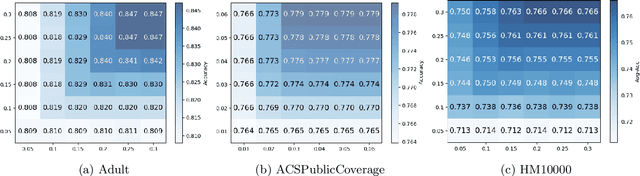
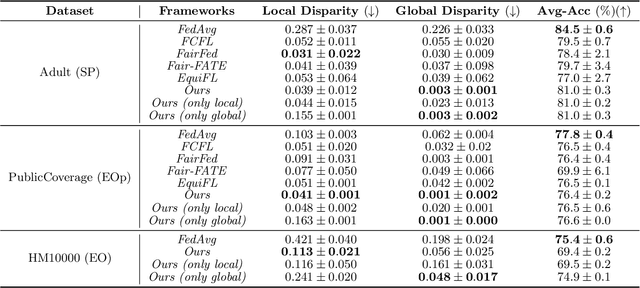

With the emerging application of Federated Learning (FL) in finance, hiring and healthcare, FL models are regulated to be fair, preventing disparities with respect to legally protected attributes such as race or gender. Two concepts of fairness are important in FL: global and local fairness. Global fairness addresses the disparity across the entire population and local fairness is concerned with the disparity within each client. Prior fair FL frameworks have improved either global or local fairness without considering both. Furthermore, while the majority of studies on fair FL focuses on binary settings, many real-world applications are multi-class problems. This paper proposes a framework that investigates the minimum accuracy lost for enforcing a specified level of global and local fairness in multi-class FL settings. Our framework leads to a simple post-processing algorithm that derives fair outcome predictors from the Bayesian optimal score functions. Experimental results show that our algorithm outperforms the current state of the art (SOTA) with regard to the accuracy-fairness tradoffs, computational and communication costs. Codes are available at: https://github.com/papersubmission678/The-cost-of-local-and-global-fairness-in-FL .
Tiny-Align: Bridging Automatic Speech Recognition and Large Language Model on the Edge
Nov 21, 2024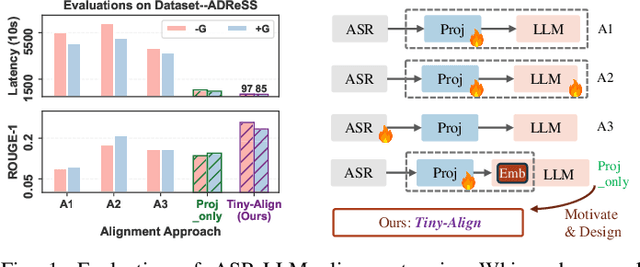


The combination of Large Language Models (LLM) and Automatic Speech Recognition (ASR), when deployed on edge devices (called edge ASR-LLM), can serve as a powerful personalized assistant to enable audio-based interaction for users. Compared to text-based interaction, edge ASR-LLM allows accessible and natural audio interactions. Unfortunately, existing ASR-LLM models are mainly trained in high-performance computing environments and produce substantial model weights, making them difficult to deploy on edge devices. More importantly, to better serve users' personalized needs, the ASR-LLM must be able to learn from each distinct user, given that audio input often contains highly personalized characteristics that necessitate personalized on-device training. Since individually fine-tuning the ASR or LLM often leads to suboptimal results due to modality-specific limitations, end-to-end training ensures seamless integration of audio features and language understanding (cross-modal alignment), ultimately enabling a more personalized and efficient adaptation on edge devices. However, due to the complex training requirements and substantial computational demands of existing approaches, cross-modal alignment between ASR audio and LLM can be challenging on edge devices. In this work, we propose a resource-efficient cross-modal alignment framework that bridges ASR and LLMs on edge devices to handle personalized audio input. Our framework enables efficient ASR-LLM alignment on resource-constrained devices like NVIDIA Jetson Orin (8GB RAM), achieving 50x training time speedup while improving the alignment quality by more than 50\%. To the best of our knowledge, this is the first work to study efficient ASR-LLM alignment on resource-constrained edge devices.
An Adaptive System for Wearable Devices to Detect Stress Using Physiological Signals
Jul 21, 2024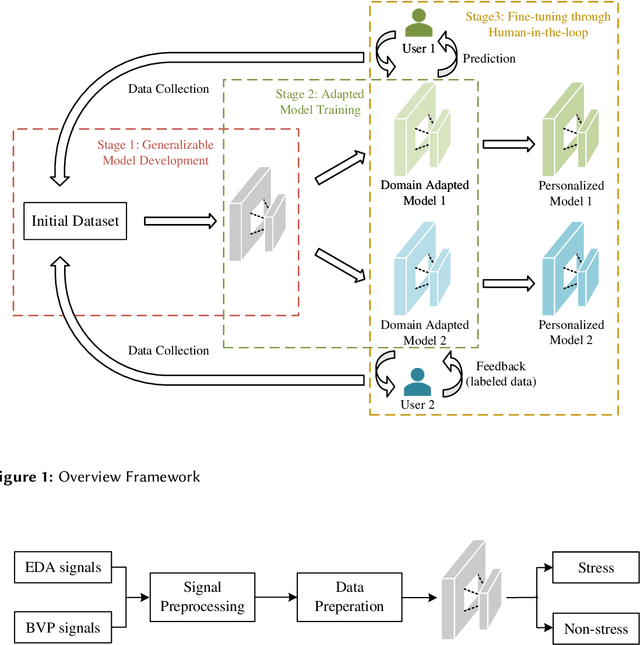

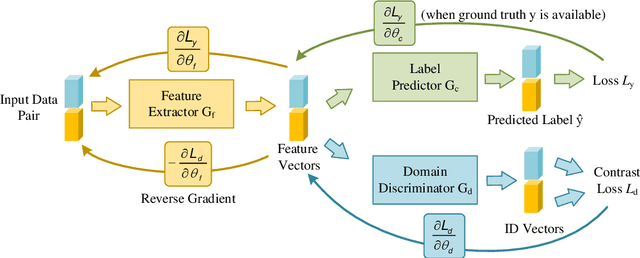
Timely stress detection is crucial for protecting vulnerable groups from long-term detrimental effects by enabling early intervention. Wearable devices, by collecting real-time physiological signals, offer a solution for accurate stress detection accommodating individual differences. This position paper introduces an adaptive framework for personalized stress detection using PPG and EDA signals. Unlike traditional methods that rely on a generalized model, which may suffer performance drops when applied to new users due to domain shifts, this framework aims to provide each user with a personalized model for higher stress detection accuracy. The framework involves three stages: developing a generalized model offline with an initial dataset, adapting the model to the user's unlabeled data, and fine-tuning it with a small set of labeled data obtained through user interaction. This approach not only offers a foundation for mobile applications that provide personalized stress detection and intervention but also has the potential to address a wider range of mental health issues beyond stress detection using physiological signals.
Enabling On-Device Learning via Experience Replay with Efficient Dataset Condensation
May 25, 2024Upon deployment to edge devices, it is often desirable for a model to further learn from streaming data to improve accuracy. However, extracting representative features from such data is challenging because it is typically unlabeled, non-independent and identically distributed (non-i.i.d), and is seen only once. To mitigate this issue, a common strategy is to maintain a small data buffer on the edge device to hold the most representative data for further learning. As most data is either never stored or quickly discarded, identifying the most representative data to avoid significant information loss becomes critical. In this paper, we propose an on-device framework that addresses this issue by condensing incoming data into more informative samples. Specifically, to effectively handle unlabeled incoming data, we propose a pseudo-labeling technique designed for unlabeled on-device learning environments. Additionally, we develop a dataset condensation technique that only requires little computation resources. To counteract the effects of noisy labels during the condensation process, we further utilize a contrastive learning objective to improve the purity of class data within the buffer. Our empirical results indicate substantial improvements over existing methods, particularly when buffer capacity is severely restricted. For instance, with a buffer capacity of just one sample per class, our method achieves an accuracy that outperforms the best existing baseline by 58.4% on the CIFAR-10 dataset.